If you are dealing with knee pain, you already know how frustating it is. Simple things like getting up from a chair, climbing stairs, or even walking to the kitchen feels like a task. And the worst part? Most people either ignore it for too long or just take painkillers without doing anything about the root cause.
I am Dr. Yogitaa Mandhyaan, physiotherapist and founder of Shape and Strength, and I have been working with knee pain patients for over 19 years now. Every week I see people walking in with knee pain at different stages. Some come with early stage joint discomfort, some come after surgery, and some have been living with chronic pain for years. And in almost every case, the right physiotherapy exercise for knee pain has made a huge difference.
So in this blog, I just want to share what we actually do here and what you can start doing at home too.
Why Knee Pain Happens in the First Place
Before jumping into the exercises, lets understand why the knee hurts. The knee joint is one of the most used joints in your body. It carries your full body weight with every step.
So naturally, if the muscles around it are weak, or your posture is off, or you sit for too long at a desk (which honestly most people in Kolkata do now), the knee starts to suffer.
Common reasons we see in our patients:
- Weak quadriceps and hamstrings
- Osteoarthritis, specially in people above 40
- Old sports injuries that never fully healed
- Weight issues putting extra load on the joints
- Bad sitting and standing posture for years
The good news is, for most of these conditions, physiotherapy exercises for knee joint pain can genuinely help reduce pain and improve your movement without surgery or heavy medication.
Can Exercise Really Help With Knee Pain?
Yes. And I say this not just from textbooks but from watching patients actually recover.
A lot of people think rest is the answer. They stop walking, stop doing anything, and just wait for the pain to go away. But actually, that can make things worse. The muscles get weaker, the joint becomes more stiff, and pain increases.
What helps is controlled, targeted movement. The exercises I am going to share below are specifically designed to strengthen the knee without putting too much stress on it. These are the same kind of exercises we prescribe here at our centre in Deshpriya Park, South Kolkata.
Physiotherapy Exercises for Knee Joint Pain (Start Slow, Please)
One important thing before you start. If your pain is severe, or if you have had a recent injury or surgery, please don’t just start these on your own. Come in for a proper assesment first. Everyone’s knee condition is different and what works for one person may not be right for another.
But if your pain is mild to moderate and you want something to start with, here you go.
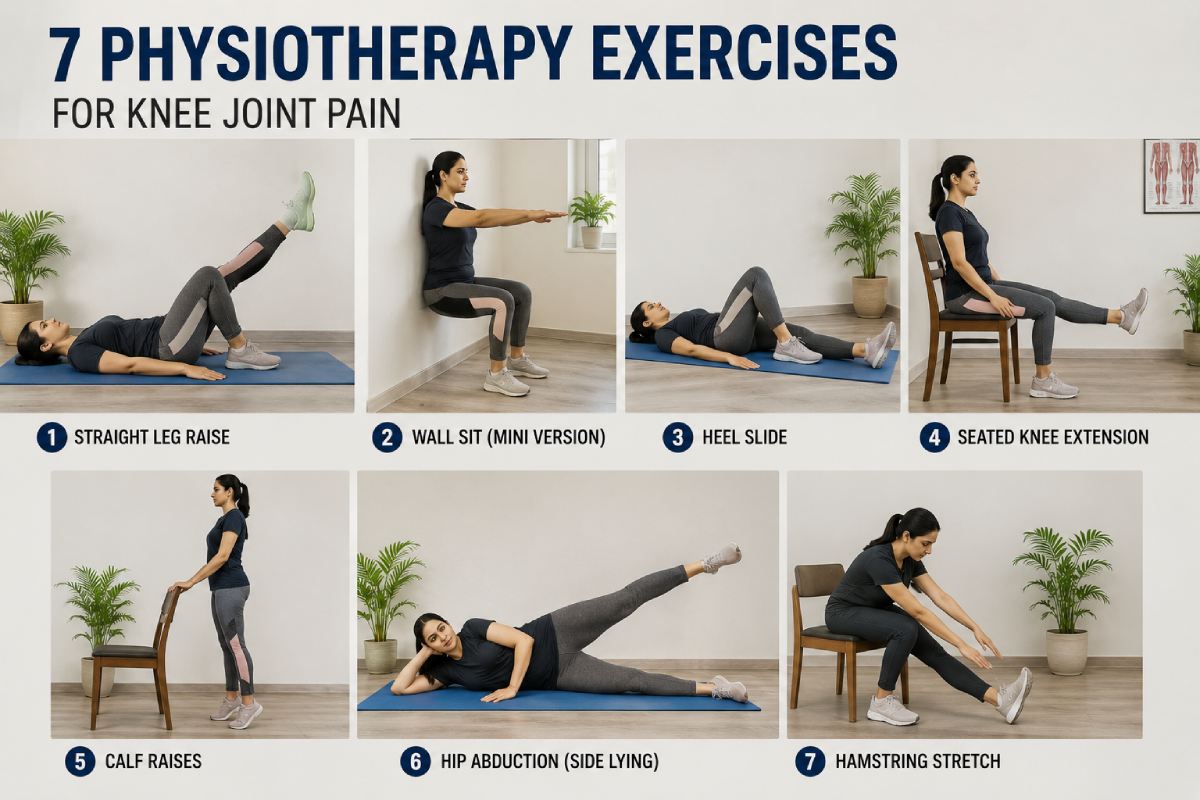
1. Straight Leg Raise
This is probably the safest exercise to start with. It targets your quads without bending the knee, which means very little stress on the joint itself.
How to do it: Lie flat on your back on a mat or firm bed. Keep one leg bent with foot flat on the floor. Now slowly raise the other leg (keeping it straight) about 30 to 45 degrees up. Hold for 3 to 5 seconds, then slowly bring it down. Do this 10 times, then switch legs.
This is one of the first exercises we start with for patients who have knee pain and can’t even bend the knee comfortably. It gently activates the muscles and is perfect for beginners.
2. Wall Sit (Mini Version)
Yes, wall sits. But a modified version, not the full squat position.
Stand with your back against the wall. Slide down slowly untill your knees are at about 20 to 30 degree angle. Not all the way down. Hold for 10 to 15 seconds, come back up. Repeat 5 times.
This is excellent for learning how to increase knee strength without overloading the joint. Over time, as your muscles get stronger, you can go a little lower and hold a little longer.
3. Heel Slide
Another very gentle one. Lie on your back. Slowly slide your heel towards your buttocks by bending the knee as much as you comfortably can.
Hold for 3 seconds, then slide back. This is one of the best stretching exercises for knee pain because it works on knee flexion without any added weight.
Do 10 repetitions on each side.
4. Seated Knee Extension
Sit on a chair. Slowly extend one leg untill it is straight. Hold for 5 seconds, then bring it back down. You can add a small ankle weight as you get stronger.
This directly targets the quad muscle, which is the main muscle that supports the knee. People always ask me how to strengthen knees and honestly, this exercise is one of the best starting points.
5. Calf Raises
Stand behind a chair and hold the back for balance. Slowly rise up on your toes, hold for 2 seconds, then come back down. Do 15 repetitions.
This sounds simple but it actually improves the overall stability of your lower leg and takes some load off the knee joint. We recommend this for almost all our knee pain patients regardless of age.
6. Hip Abduction (Side Lying)
Lie on your side. Keep your bottom leg slightly bent for stability. Now raise your top leg to about 45 degrees, hold for 3 seconds, bring it down. 10 to 12 repetitions, then switch sides.
The hip muscles and knee health are more connected than most people realise. Weak hips often lead to poor knee alignment, which causes or worsens pain. So exercises for knee pain are not just about the knee itself.
7. Hamstring Stretch
Sit at the edge of a chair. Extend one leg straight infront of you, keep your back upright, and lean forward slightly from the hips untill you feel a gentle stretch at the back of the thigh. Hold for 20 to 30 seconds, then switch.
Tight hamstrings are a very common finding in people with knee pain, specially those who sit for long hours. This stretching exercise for knee pain helps relieve that tension and improve how to reduce knee joint pain over time.
How Often Should You Do These?
Ideally, start with 3 to 4 days a week. Don’t do all 7 exercises in one session on day one. Pick 3 or 4, do them properly, and see how your knee feels the next day. If there is no increase in pain, you can continue. If the pain increases, stop and consult a physiotherapist.
Most of our patients at Shape and Strength start seeing improvement within 2 to 3 weeks of consistant exercise. But it depends on the severity of your condition.
What to Avoid When You Have Knee Pain
As much as these exercises help, there are few things that can make your knee worse:
Deep squats or lunges without proper guidance. High impact activities like running or jumping on hard surfaces. Sitting with legs crossed for long periods. Ignoring pain and pushing through. Wearing unsupportive footwear.
We also advise patients on posture correction and ergonomics because a lot of knee problems are linked to how we sit, stand, and even sleep.
When Should You See a Physiotherapist?
If your pain has been going on for more than 2 weeks, if it is affecting your sleep, if you have swelling or stiffness in the morning that doesn’t go away, or if the pain started after an injury, please don’t wait any longer. Home exercises are a great starting point but they are not a replacement for proper diagnosis and treatment.
At Shape and Strength, Dr. Yogitaa Mandhyaan does a thorough musculoskeletal assessment before prescribing any exercise plan. We don’t just give you a generic sheet of exercises. We evaluate your gait, your posture, your muscle strength, and then create a plan that is specific to your knee condition.
We use a combination of manual therapy, electrotherapy, PEMF, and therapeutic exercises depending on what your knee needs.
A Quick Word to Kolkata Residents
If you are in South Kolkata, and dealing with knee pain, you don’t have to go all the way to some big hospital and wait for hours. We are right here at 16C Bipin Pal Road, Deshpriya Park, near Kalighat. You can book an appointment directly through our website or just give us a call.
We have treated patients from all over Kolkata and even from cities like Kharagpur and Burdwan who travel specifically because of our personalised approach to physiotherapy.
Final Thoughts
Knee pain is common but it doesn’t have to be permanent. With the right physiotherapy exercise for knee pain, consistent effort, and proper guidance, most people can significantly reduce their pain and get back to living normally.
Start with the simple exercises mentioned above. Be patient with yourself. And if things don’t improve, please don’t keep waiting.
As a best physiotherapist in Kolkata, I have seen how early intervention makes a massive difference in recovery. The longer you ignore knee pain, the harder it becomes to treat. So if you have knee pain and want proper, personalised care, please visit Shape and Strength, the best knee pain treatment in Kolkata. We will assess your condition properly and create a plan that is right for you, not just some generic advice.
Your knees do a lot for you every single day. It’s time to take care of them properly.